"Better a fallen rocket than never a burst of light."
~ Tom Stoppard, The Invention of Love
Showing posts with label The Grandmaster. Show all posts

Friday, April 15, 2022

A Little TLC(w): The Grandmaster: The Chinese Cut (2013, PG-13)

Ever since I learned that the international/U.S. release of The Grandmaster is significantly shorter than the version that was released in Hong Kong, I’ve wanted to see the original cut of the film. Years ago, I read a review comparing the two versions, and the writer maintained that the original cut was the superior one, but that the U.S. version could function as a “codex” to better understand the denser, more complex Chinese cut.

I knew I wanted to see the Chinese cut, but I didn’t know how to find it. I consulted Ebay, my go-to spot for Tony Leung Chiu-wai movies I can’t get in the U.S., but sellers didn’t appear to label which version of the film they had, and I didn’t want to spend money on a second copy only to get it and discover it was the same version I already owned. (Why didn’t I message sellers and ask them which cut they had? A valid question with an important, introvert-related answer.) Finally, though, I was turned onto a copy of the Chinese version of the film.

The Grandmaster follows Ip Man, the expert martial artist who went on to teach Bruce Lee.  Not that the film focuses on Lee, instead exploring Ip’s life before, during, and after WWII.  His craft comes of age in the 1930s, when kung fu in China divides along geographic lines.  Ip is a southern artist, and the film is marked by his encounters with Gong Er, the daughter of the renowned northern grandmaster.  Like all of Wong’s works, the story flows, river-like, between ideas, rather than following a more traditional three-act plot. 

Though I’ve seen the U.S. cut of The Grandmaster multiple times, it’s probably been at least five years since I last watched it, so I couldn’t swear to what was a change between versions and what wasn’t—before writing this review, I went back to that old comparison article to refresh my memory. There were certain scenes that immediately stuck out as new to me. There are more scenes involving the Razor, the lethal martial artist played by Chang Chen, but as it happens, his single scene in the U.S. cut (where he comes up against Ip Man) isn’t in this version. We also get more about the Sino-Japanese War as it’s happening, such as scenes of Japanese flags hung in the brothel where the martial artists gather and seeing characters we know executed by Japanese soldiers.

Gong Er’s storyline is expanded, and this cut arranges her storyline to be happening more concurrently with Ip Man’s. In the U.S. cut, we primarily follow Ip Man, and when we catch up with Gong Er, the narrative doubles back on itself and we explore her history in the context of Ip Man learning about it. Here, we move between Gong Er in the north and Ip Man in the south (and later relocating to Hong Kong.) The thread of wistful longing between the two is also highlighted more. These differences make the film much more of a dual protagonist narrative, with more emphasis on the romantic aspects.

At the same time, we also get much more of Ip Man’s wife, a character who’s practically a background character in the U.S. cut. Even though only a few short scenes are added for her, they open up her character and her relationship with Ip Man in delicate, fascinating ways, which only makes Ip Man’s dynamics with Gong Er even more complex.

It’s interesting. On the whole, I’d say the Chinese cut of The Grandmaster makes for an even fuller, richer experience, one that feels more firmly grounded in Wong Kar-wai’s aesthetic and sensibilities. And yet, there’s very little extra material here for Leung as Ip Man. Some of his voiceover dialogue is different, and of the handful of added scenes for him, most of them focus primarily on character action and have little dialogue. For instance, there’s a scene of Ip Man breaking apart his wooden training post after the war hits and money is tight. Little things, and again, they add up to further flesh out his character, but there aren’t very many acting scenes that were left on the cutting room floor between versions. Which I suppose makes sense—I mean, if I had to cut 20 minutes out of a Tony Leung Chiu-wai movie for U.S. audiences, I’d cut as little of Leung’s performance as possible!

Recommend?

In General – If you can find it, I would. This version of the film is well worth seeing and does create a somewhat different viewing experience.

Tony Leung Chiu-wai – Sure (again, if you can find it.) Even though Leung’s scenes are probably more than 95% identical to the U.S. cut, I do like the little extra nuances brought out here.

Warnings

Tons of sumptuous kung fu action, some smoking, brief drug use, and a little swearing.

Saturday, December 2, 2017

Favorite Characters: Ip Man (The Grandmaster)

Since yesterday's News Satire Roundup came a day late, I'm also throwing in the A Little TLC(w)-related post I had in the docket for today.

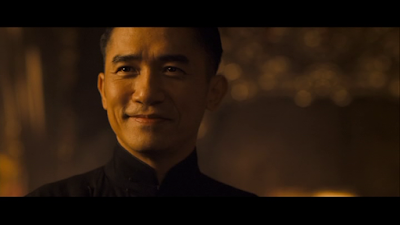
I don’t know enough about the real Ip Man to know how Tony Leung Chiu-wai’s portrayal of him compares (knowing Wong Kar-wai, my assumption would be that the artistic license is pretty broad,) so I can’t talk about this performance from that standpoint.  I can talk about him purely as a character, though, and that’s what we’re doing today.  First, here’s the A Little TLC(w) addition to my Grandmaster review.  “Recommend?  In General – I would.  As a kung fu movie, it’s fairly slow and artistic, but it’s ultimately a beautiful film with a lot more richness than is immediately apparent.  Tony Leung Chiu-wai – Yes.  This is a subtle but rewarding performance, and in Leung’s hands, the action scenes look like music.”

It’s hard to get too much of a handle on Ip Man.  He isn’t just one thing, and on first impressions, he can feel pretty muted.  What do we know?  We know he’s a revelatory Wing Chun artist, one who often seems happy enough not to fight someone but who will willingly oblige when necessary.  We know he’s thoughtful and intelligent, somehow modest and self-assured at the same time, standing a little bit apart and yet deeply connected, very unassuming but also kind of magnetic.

How do you put all that together?  One could easily look at Leung’s understated performance and say there’s not much going on here, but I find more every time I watch this movie.  As you can see from the above paragraph, Ip Man can elude you a bit; every time you think you have him pinned down, he shows himself to be the near opposite.  Take the juxtaposition of his humility and confidence.  When he’s chosen to fight the Northern Master, he asks, softly and politely, why he’s been selected when there are so many others with more experience or acclaim.  He’s not arguing against taking part in the match exactly – more, he’s just expressing genuine confusion as to why the others picked him.  And yet, every time you see him fight, he just exudes this air of quiet confidence.  He’s the man, but he knows it in such a way that he doesn’t have to go around proclaiming it or itching to prove it.  He just gently goes just about his business, and if you invite him to, he’ll soundly kick your ass with this balletic, still-waters grace.

It’s beautiful to watch him fight (as a novice martial artist, Leung looks best in highly artistic films like this one or Hero, where it’s more about the camera work and the beauty of the movements than the technical precision of the moves – he’s never gonna be Donnie Yen or Daniel Wu, but in this kind of film, he does his job well.)  He’s a deeply introspective fighter.  In all the action scenes, you can see him reading his opponent’s every move in his eyes, quietly taking it all in and putting it together in his mind.  Whether he’s learning from another’s skill, gently amusing himself in demonstrating his own to someone who doubts it, or taking the sincerest pleasure in meeting his match, he never feels more him than when he’s doing kung fu.

Like many Wong Kar-wai characters (because, as I said, this is very definitely Wong’s version of Ip Man,) he suffers silently from the choices he doesn’t make.  This character is so still and so quiet, but Leung speaks volumes with his eyes.  Nearly everything between Ip Man and Gong Er is unspoken, but even if you don’t quite know what’s between them, it’s wrenching to see them just fall short of reaching one another, to have their chances come a bit too late.  As in all things, Ip Man doesn’t rage over or lament it – instead, whatever pain he feels, he carries it, not burying or denying it but not sinking under it, either.  It seems to sort of seep into him, becoming him but not fully being him.

In short?  For a low-key performance, there’s a lot going on here, and Leung tears it up in the subtlest of ways.

Friday, May 29, 2015

The Grandmaster (2013, PG-13)

This movie came nine years after 2046, Wong Kar-wai’s last Chinese film (true, only six years after My Blueberry Nights, but I have a hard time counting that as one of his.)  It was also the first film of his I saw on the big screen.  With all that behind it, it falls slightly short of my anticipation, and it also feels a bit un-Wong-like, but it’s still quite something.

One departure is its basis as a true story:  The Grandmaster follows Ip Man, the expert martial artist who went on to teach Bruce Lee.  Not that the film focuses on Lee, instead exploring Ip’s life before, during, and after WWII.  His craft comes of age in the 1930s, when kung fu in China divides along geographic lines.  Ip is a southern artist, and the film is marked by his encounters with Gong Er, the daughter of the renowned northern grandmaster.  Like all of Wong’s works, the story flows, river-like, between ideas, rather than following a more traditional three-act plot. 

On the kung fu front, this movie makes me wish I knew more about it, because I think I’d find the film much richer if I did.  It contemplates various schools of the art, with some fights set up like tutorials – half lecture, half demonstration.  As such, the action is fastidiously choreographed to reflect the particular affiliation of each artist, undoubtedly a feast for any kung fu enthusiast.  (Be warned, this also means the action can be slow at times, either interrupted by explanations or literally slowed down to emphasize the craft.)  That said, it’s uniquely gorgeous.  The fighting is by turns educational (Ip’s demonstration of Wing Chun’s eight kicks,) picturesque (the opening fight in driving rain,) and emotionally-charged (the climactic scene of Gong fighting beside a train.)  It also highlights Wong’s ability to imbue anything with romance.  I don’t just mean “Shall I compare thee to a summer’s day?” romance, though there’s definitely some of that.  I mean a startling sense of beauty that almost aches, an electricity in the air binding the characters together through individual paths.  Movement, colors, and music saturate the film, nearly overwhelming in its intimacy.  It’s this type of romance that distinguishes it as a Wong film.

The story itself, less so.  I already mentioned that it does maintain Wong’s usual meandering structure, but overall, it feels much more “written” than many of his films.  Most of the time, the actual words in Wong’s movies are a stylistic blend of incredibly precise, everyday-poetic voiceovers and long scenes of rough-hewn improvised dialogue.  Here, the writing feels a lot more preplanned; the dialogue contains plenty of carefully-formed “golden phrases.”  Don’t get me wrong – it’s lovely, but it’s not what I expect going into a Wong film, and that means it doesn’t quite capture my normal experience of watching his movies.

At this point, it doesn’t quite feel like a Wong movie if Tony Leung Chiu-wai’s not in it, and he’s superb here as Ip.  His quiet performance is uniformly wonderful, all intent observation and understated emotion.  As Gong, Ziyi Zhang gives a performance I’ve never seen from her before, very brittle and controlled, but brimming with unspoken passions that bubble over when pressed.  Chen Chang, who worked with Leung (and Wong) in Happy Together and Zhang in Crouching Tiger, Hidden Dragon, makes a small appearance as a kung fu expert.

Warnings

Tons of sumptuous kung fu action, some smoking, brief drug use, and a little swearing.