"Better a fallen rocket than never a burst of light."
~ Tom Stoppard, The Invention of Love
Showing posts with label 1590s. Show all posts

Saturday, January 6, 2024

Richard III (2023)

I caught the PBS recording of this Shakespeare in the Park production last year, but I didn’t get around to writing about it until now. Unfortunately, this is one that I think could’ve been better. Despite a compelling central performance and some interesting concepts, the production had a hard time sustaining my attention.

Richard, the Duke of Gloucester, is jealous of his brother King Edward IV and resentful of the brothers and nephews who block his own path to the throne. Through manipulation and murder, he schemes to seize the crown for himself.

Over the years, many an actor has adopted the trademark “hump and withered limb” look to play Richard, though some productions interpret his “deformity” in other ways. Here, Richard has no visible disability, but he’s the only Black member of his family, and there are enough references in the script to people being “fair” to highlight the contrast. Furthermore, with Danai Gurira as the lead, we see his toxic masculinity as portrayed by a woman.

Gurira’s casting was how the production caught my eye, and she’s definitely my favorite thing about it. Her Richard is very mercurial, by turns charming, conniving, and scheming. She’s great to watch and a really interesting take on the character.

I also like that, while Richard isn’t visibly disabled, numerous other members of the cast are, including Tony winner Ali Stroker as Lady Anne. It also includes a few Deaf cast members who perform in ASL, which is sometimes interpreted by other characters onstage and sometimes subtitled.

But while Gurira is terrific and I like the inclusive casting, the production drags for me. To be fair, it’s been a number of years since I read Richard III, which can make watching the play more difficult. That said, a great production can easily make me feel the dialogue without a recent read, and I don’t think this one always rises to the occasion. The direction doesn’t do much to help the actors along, and with a lot of characters, it can be hard to keep track of everybody.

I’m still glad I watched it, but I think it could’ve been done better. The casting is so interesting and has a lot of potential, especially with Gurira’s strong performance as an anchor. For the actors’ sake, I wish the production had risen more to the occasion.

Warnings

Violence, sexual references, drinking, and thematic elements.

Wednesday, November 25, 2015

A Few Notes on Juliet (Romeo and Juliet)

As a tragedy, Romeo and Juliet is fairly engrossing; as a love story, it’s pretty ridiculous.  I think we all know this, so I won’t get into that.  What I will get into is an interesting nugget that struck me the last time I read the play, dealing with Juliet and her father at the end of Act III.

So, context.  At this point, Juliet has married Romeo in secret, and Romeo, having killed her cousin in a feud-related street fight on his way home from their wedding, has been banished to Mantua.  He’s just said his goodbyes to her, staying in town long enough for them to have a wedding night before making himself scarce.  Friar Laurence is their ally, and they’re planning to bide their time until he comes up with a way reconcile their families to their marriage and Romeo can come home.

That’s the state of affairs when Lord Capulet throws a huge wrench in the whole “bide their time” plan – he’s decided that Juliet will marry Paris in two days.  She makes every protest she can think of, both reasonable and emotional, but he hears none of it.  (In truth, he’s downright vicious.  At the start of the play, his approval of Paris depends on Juliet’s feelings:  “An she agree, within her scope of choice / Lies my consent and fair according voice.”  The second she says that she doesn’t want to marry Paris, however, he turns on her absolutely.  It’s creepy.)

This exchange understandably puts Juliet in a state, and it spurs Friar Laurence to come up with the fateful faked-death plan that culminates in both Romeo and Juliet killing themselves over what basically amounts to a miscommunication and bad timing.  (Harsh, right?)  But the thing is, there was no need for an overly-complicated stratagem that involved lots of subterfuge and relied on a message being delivered by hand in a timely manner.  There was no need for Juliet to take drugs that nearly stop her heart, make her family think she’s dead, or lay her in her family crypt and wait for someone to break her out when she comes to.  This is because, during the very conversation that incites the creation of this insane plan, her dad gives her an out.

In the midst of his tirade, Lord Capulet makes it clear that, if Juliet doesn’t marry Paris, she’s breaking with the family.  “Get thee to church o’ Thursday,” he tells her, “Or never after look me in the face.”  Essentially, marry Paris or get out.  And because this is the scene in which Lord Capulet shows how awful he is, he makes no bones about it.  He goes on to say, “An you be mine, I’ll give you to my friend; / And you be not, hang, beg, starve, die in the streets, / For, by my soul, I'll ne’er acknowledge thee, / Nor what is mine shall never do thee good.”

This is Juliet’s chance.  She couldn’t have gone with Romeo to Mantua earlier, because her movements are too heavily dictated by her parents.  But here, her dad is saying that, if she doesn’t fall in line, she can leave home and never come back, starving for all he cares (once again – such a standup guy.)  Leaving home, what would she be able to do?  Join Romeo, be with him like she wants.  No crazy plan necessary – her dad is practically holding the door open for her.  But Juliet doesn’t take this chance.  Why?  It seems there are two forces pulling Juliet here.  She wants to be with Romeo, but she doesn’t want her family to think less of her.  She doesn’t want to be anything other than their good daughter.  At the end of the day, she would rather have them believe she’s dead than think that she defied them.  And that desire, in its own way, contributes to the end of her life.

Thursday, September 4, 2014

Exploring House of Cards Through Richard III

 
Though I finished and reviewed Richard III not long ago, I didn’t get around to comparing it with House of Cards as I’d planned.  Until now!  Having read one and watched the other, the common threads between the two stories are clear, especially between the two main characters.
 
Both Richard and Frank have the whole “smartest, sneakiest guy in the room” thing going on, further accentuated by their frequent asides to elaborate on their plans or scorn the stupidity of others.  Obviously, both have their eye on the highest seat in the land and have no qualms about how they attain it.  Plus, it’s not a simple matter of taking out one person – there’s an entire series of hoops to jump through, which requires a complex, multifaceted plan of carefully-balanced wheels within wheels.
 
I had to stop and think for a moment about Richard; though he, like Frank, is certainly fond of intricate manipulations that usually end which his victim destroying themselves, that’s largely his weapon of choice in his own play.  Earlier in the tetrad, he’s much more overt in his takedown of his opponents.  He’s openly hostile, relishing in battle and personally killing a number of his enemies.  I realize, though, that someone needs different tactics for destroying their own family from within than for crushing an acknowledged foe.  There’s no real call for Richard to play nice with the Lancasters, but he’s part of the house of York.  He lives among the people who are in his way – brothers, nephews, and so on – and can’t afford to just commence with the bloodshed.  So, he gets clever and underhanded, instead playing them all like chess.
 
In a way, I suppose Frank is the same.  He can be more openly combative against the Republicans because they’re the opposing party (though he still has to conceal his less legal activities,) and the Democrats enjoy reaping the benefits of his mercenary methods.  However, when he’s gunning for the people above him in his own party, he has to do it subtly.  He has to nurture their trust, isolate them from all voices but his, and gradually undermine them until they’re backed into a corner and can’t escape.
 
Not that the two characters are entirely the same.  There’s Frank’s wife Claire, a partner in Frank’s aims as he is in hers, and the sense of warped vindication that plays a role in Frank’s desire, not just to supplant President Walker, but to eviscerate him.  The biggest difference to me, though, is Richard’s much-talked-of physical deformity.  Throughout his play and the ones preceding it, other characters mock his “monstrous” appearance and cite it as proof of his internal blackness.  Frank, on the other hand, looks every bit the politician.  There’s nothing readily apparent about him that people sneer at.  I almost wonder if future episodes will use his bi-(or possibly homo-)sexuality to touch on this angle.  It’s not visible or evident, but that’s more the political game of today, isn’t it:  secret scandals coming to light and eroding a public figure’s foundation.  It might be an interesting way to go, especially since the show really doesn’t vilify Frank’s sexuality (which definitely relieves me) – there are plenty of other reasons to vilify him.  If anything, his scenes of same-sex attraction seem more honest and less opportunistic than his scenes of opposite-sex attraction and take tiny steps toward humanizing him.  For someone to try and use it against him would be much like people disparaging Richard for physical conditions over which he has no control.  I can’t decide if it’d be obvious, irritating, or intriguing, but I’m curious about the idea.  Sigh… how many months until season 3?

Friday, August 22, 2014

Richard III (circa 1592)

My self-assigned summer reading list included a tetrad of Shakespeare histories, all of which come to a head in this famous play.  I’m glad to have finally read it – with Shakespeare, it’s definitely a case of “so many plays, so little time.”  While I don’t find it as astonishingly well-written as my favorites of his, it’s a fine play about a fascinating character.
Reading through of the first 75% of the tetrad, the three Henry VI plays, I was surprised that Richard appears at the end of part 2 and takes a significant supporting role in part 3.  Richard III is so well-known, but I hardly ever hear people mentioning the Henry VI plays, so it’s strange to think of it as a conclusion to a larger story.  But now, having read all four plays in succession, I can’t quite imagine knowing it out of context.  Although it’s clearly the best-written of the four, the play itself exists best in conjunction with the other three.  (It helps to have read the Hollow Crown tetrad as well, written later but set earlier.  There are a handful of references to people and events from these plays that I wouldn’t have gotten otherwise.  This is what happens when you’re not up on your medieval English history – you have rely on what Shakespeare tells you.)
Anyway, Richard III is the story of how Richard, the deformed, duplicitous Duke of Gloucester, contrives against those standing between him and the crown, including his older brother and his young nephews.  A self-proclaimed villain, there’s nothing Richard won’t do to advance his aims.  His utter lack of compunction served his family well in the earlier plays, when his House of York wrestled the crown from the House of Lancaster and his oldest brother became king – he gladly got his hands dirty to further the cause of York.  Now, though, that same ambition has turned his own flesh and blood into enemies, and Richard isn’t an enemy you want to have.
It’s interesting to look at Richard from our modern viewpoint.  Where Shakespeare says “villain,” we would probably say “psychopath,” and indeed, many hallmarks of psychopathy are present and specifically acknowledged within his character.  He has no sense of remorse or empathy, and he views people as inconsequential pawns he uses for his purpose.  Though he’s not emotional (in earlier plays, he’s the only one not to weep when members of his family are killed,) he’s skilled at mimicking the requisite feelings and is a master manipulator who plays just about everybody. 
As far as the text goes, it’s rich with excellent lines.  Many of them come from Richard himself:  the dark dramatic irony in his deceptions, the hungry vigor in his soliloquies, and the scathing aspersions hiding under his barely-feigned niceties.  My biggest shock, quote-wise, comes at the very start, in line 1.  I honestly had to laugh when I discovered that “Now is the winter of our discontent” is immediately followed by “…Made glorious summer by this sun of York; / And all the clouds that lour’d upon our house / In the deep bosom of the ocean buried.”  So basically, everything is awesome and everyone who’s ever cribbed this quote is saying the exact opposite of this speech?  Yeah, sounds about right.
Warnings
Lots of heinous acts of villainy, a fair amount of violence (including murder and battle scenes,) and plenty of Elizabethan innuendos.

Tuesday, July 29, 2014

Favorite Characters: Beatrice (Much Ado about Nothing)


Let's face it:  no one reads Much Ado about Nothing for Claudio and Hero.  It's all about Benedick and Beatrice, and really, it's about Beatrice.  This Shakespearean lady is cooler, funnier, and fiercer than most female leads you see in today's romcoms.

Hero, undoubtedly, is the prototypical fairy tale princess.  Men fall in love with her at a glimpse, and, to borrow from another Shakespeare play, she's the one teaching the torches to burn bright.  She reminds me of one of Dickens's "angels of the house," but this ain't the Victorian age.  It's the Elizabethan era, where the Rosalinds and Portias take center stage in the happy endings.

Enter Beatrice.  Older and sharper than Hero, less rich and sweet, she's not the automatic prize her young cousin is, and while she knows this, she doesn't mind.  She has no plans to secure a husband, and she takes pleasure in mocking her uncle's expectations of what a young lady ought to do.  But right from the start, Beatrice explodes off the page.  While Hero can literally go hundreds of lines without speaking in mixed company, Beatrice dominates every scene she's in.  Men fall in love when they see Hero, but with Beatrice, they fall in love when they know her.

In the play, Benedick and his pals Don Pedro and Claudio are "wits," privileged young men-about-town who spar verbally as a recreational sport.  They can wile away hours spinning puns, slights, and innuendos, with bragging rights going to the man with the quickest tongue.  Not only, however, does Beatrice have the nerve to play with the big boys (demure she is not) - she also has more than enough brains and bite to wipe the floor with them.  She and Benedick go head-to-head numerous times, and she always gets the last word.

Where love is concerned, Beatrice is cynical without being bitter.  Her heart's bee toyed with lightly before, and that makes her keep romance at arm's length, but she's not some man-hating ball-buster.  She's playfully combative with Benedick, and when Don Pedro takes their mutual flirting a bit too sincerely for her comfort, she lets him down gently.  And when she does eventually find herself in love, she as usual has to outdo her beau; while Benedick gives his soliloquy o' love in blank verse, Beatrice's is a sonnet.

She's careful in romantic matters of the heart, but she's very free with her affections to her cousin.  She's forever advising Hero to go after what she, rather than her father, wants, as well as encouraging Hero to speak up for herself.  When Hero's happiness is threatened, Beatrice is the only one whose support never wavers.  She rages on her cousin's behalf, and her own potential happy ending takes a back seat to repairing Hero's.

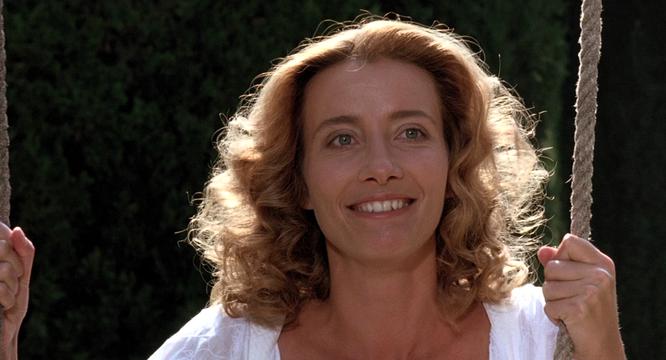
Is it any wonder she's been played variously by the likes of Emma Thompson, Catherine Tate, and Amy Acker?  I can't imagine too many roles that must be more universally coveted by actresses.